
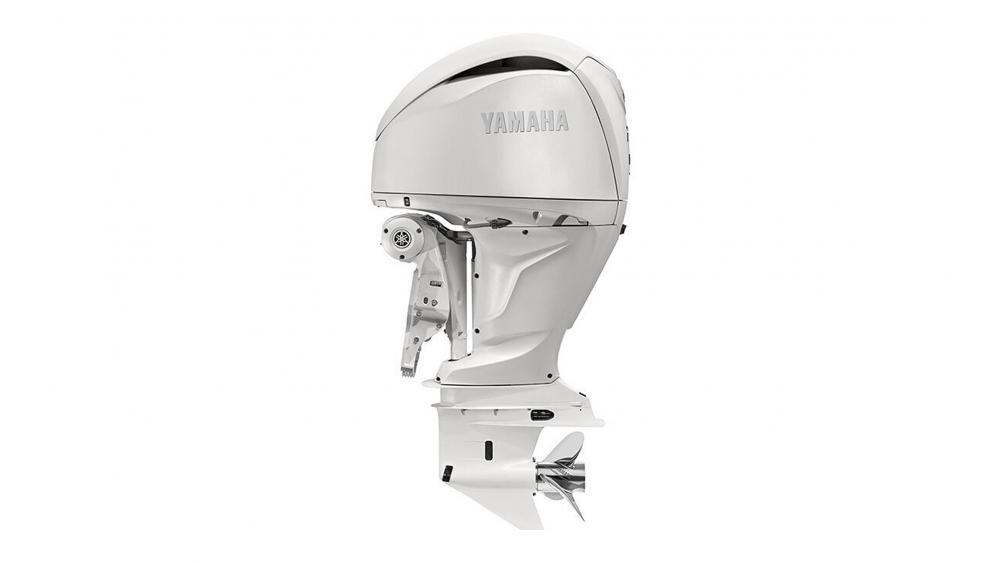
300 hp Yamaha twin engine system
Yamaha F 300 XSB & LF 300 XSB
€59,990 €81,222

Yamaha Outboards
The history of the Yamaha companies began in 1887 with Torakusu Yamaha and his interest in organs and harmoniums. The company he founded, Nippon Gakki, quickly made a name for itself with musical instruments (and continues to do so today). In 1955, Yamaha Motor was founded as a subsidiary. Founder Genichi Kawakami had already been working at Yamaha for 16 years when, in 1953, he had the idea of producing motorcycle engines on a trial basis. This marked the beginning of the legendary history of Yamaha motorcycles, which now includes well over 100 models. Relatively early on, in 1963, Yamaha Motor also began selling boat engines in Germany. The two Yamaha groups remained intertwined, even though Yamaha Motor is now independent. Incidentally, it was not until its 100th anniversary that the parent company was renamed Yamaha Corporation.
Today, thanks to its long-standing success, the engine manufacturer stands for experience and reliability like no other brand. Yamaha grew up with motorsports, and this passion for racing, engines, and speed is still an important corporate principle.
The premium segment of Yamaha outboard motors is divided into the XTO and V6 models. The XTO models are the leaders in this segment. They equip larger boats with the appropriate powerful performance. With increased torque and high speed, they take performance on the water to a new level. The Yamaha 425 is the first four-stroke engine with direct injection and the first outboard motor with integrated electronic steering and seamless integration of the Helm Master® system.
The 250 to 300 hp engines share many of the features of their larger XTO siblings, particularly in terms of equipment and design. The V6 engines are equipped with features such as Digital Electric Steering (DES), Yamaha's exclusive TotalTilt™ function, and Thrust Enhancing Reverse Exhaust (TERE).
The upper performance range includes four-cylinder engines with electronic fuel injection (EFI). Although these engines are not as powerful as the outboard motors in the premium segment, they are fuel-efficient and equally state-of-the-art. A lot of modern technology is also used here. These engines are controlled by an ECU microprocessor. This enables a reduction in pollutants and noise.
Depending on the model, Yamaha outboard motors in the high-power segment feature variable cam timing (VCT), variable trolling speed, SDS damping for smooth gear changes (depending on the propeller type), and a powerful alternator (50 A). The following are available as options: premium 5-inch LCD color display (200 G only), electronic anti-theft device (Y-COP), tilt angle limiter, one-touch start/stop control for at least 2 engines (200 G), dual battery charging system.
The mid-power range is perfect for boats from 4 to 6 meters. Yamaha is constantly improving these engines to make them even quieter and more powerful. The new 16-valve engine models feature a single overhead camshaft (SOHC) for rapid acceleration, an improved intake and exhaust system, and Yamaha's unique multi-point fuel injection (EFI).
Yamaha itself calls this category “versatile” and it includes both E-start and manual start models. In addition, we are in the range where models are used for both smaller GRP and rigid inflatable boats as well as larger sailboats, which means that many models are available in both standard and long shaft versions. The latest generation of Yamaha engines with 8 to 25 hp has been slimmed down again and weighs less than before. Yamaha itself claims a weight reduction of up to 25% for the 25 hp engine. The new EFI system does not even require a battery. Depending on the model, the outboards are equipped with variable trolling speed (VTS – lower than normal idle speed) and a powerful alternator for additional starting reserves. The E models are compatible with Yamaha's DNG digital instruments. Optional extras include a trim and tilt system with a wide adjustment range and the Y-COP electronic immobilizer, as well as a multifunctional tiller handle.
An important, if not the most important, feature of this class is the ability to carry them. This is ensured by compact dimensions, a large handle, and an integrated fuel tank. The CDI ignition ensures easy starting without any problems. Yamaha pays particular attention to reliability in this segment, but also to low fuel consumption, ease of operation, low noise, and low-vibration running.
DES, or Digital Electric Steering, is Yamaha's term for the digital electric steering system used in all V-6 outboard motors equipped with DBW (Drive by Wire). Drive by Wire technology enables electronic control of the throttle and shift functions. This also allows for one-touch start/stop and automatic synchronization of twin engines. The system guarantees smooth driving pleasure, as the hydraulic systems do not need to be bled. The control cables also do not become entangled over time. A particularly nice feature is that no pumps or hoses are visible at the rear of the boat. Engines from 250 to 300 hp without DBW are still compatible with DES and other hydraulic steering systems.
Yamaha-Motoren mit der TotalTilt-Funktion lassen sich aus jeder Position vollständig kippen (bis zum Kontakt des Trimmzylinder). Das geht vollautomatisch per Knopfdruck auf den Kippknopf. Während des Vorgangs sollte man sich vom Außenborder fern halten, dazu ertönt zur Sicherheit ein Geräusch. Ein integrierter Neigungsbegrenzer verhindert mögliche Schäden durch zu starkes Kippen.
The TERE system enables more powerful reverse thrust at low speeds with excellent control. The bubbles created by the exhaust gases are kept away from the propeller, thereby increasing thrust. This is particularly useful in ports with limited space. Together with the DES system, the boat is very easy to maneuver.
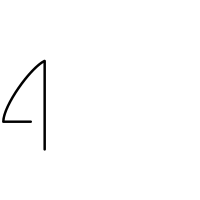
OHC, short for overhead camshaft, is the international term for a type of reciprocating four-stroke engine in which the valves are operated by one or more overhead camshafts.
DOHC stands for Double Overhead Camshaft, an OHC engine with two overhead camshafts per cylinder bank. In contrast, SOHC stands for Single Overhead Camshaft. Here, the valves are controlled by only one overhead camshaft. As a result, the cylinder head of an SOHC engine is significantly more compact than that of a DOHC engine.

F – Four-stroke engine
FL – Four-stroke engine, left rotation
FT – Four-stroke thrust engine
XF – Four-stroke engine, offshore version
A – L (first letter after the power rating) – Series
M – Manual starter
E – Electric starter
W – Manual + electric start
H – Tiller control
D – Hydraulic tilt assist
P – Electric tilt assist
T – Electrohydraulic trim and tilt system
S – Standard shaft
L – Long shaft
X – Ultra-long shaft
U – Super-ultra-long shaft
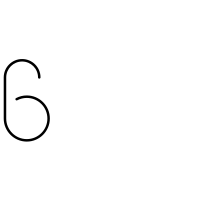
Aluminum = Aluminum
Aluminum¹ = Aluminum, Talon GP – SDS
Aluminum² = Aluminum Dual Thrust
SSTP = Polished stainless steel, Talon SDS
SSTP¹ = Polished stainless steel, Reliance – SDS
SSTP² = Polished stainless steel, Saltwater II – SDS
SSTP³ = Polished stainless steel, XTO – SDS
Follow us on: